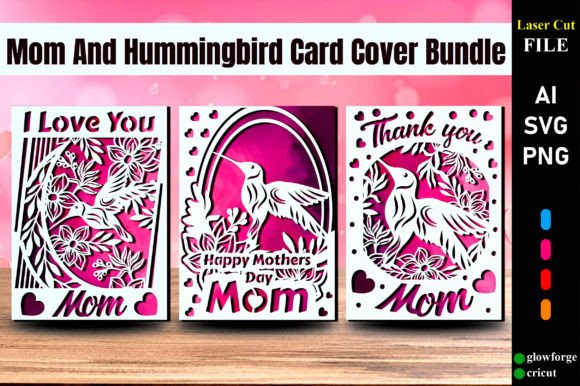
Mom and Hummingbird Card Cover Bundle: A Designer's Review
When I first opened the Mom and Hummingbird Card Cover Bundle, my immediate reaction wasn't just about the cuteness of the theme; it was about the structural integrity of the lines. As a designer who spends hours staring at stitch simulations and handling finished handmade products, I look for more than just a pretty picture. I need to know if a design will hold up under the needle, how it translates to different fabric textures, and whether it offers enough versatility to justify its place in my library of design assets. This bundle, categorized under Crafts and Graphics, presents itself as an instant digital download, but the real test is how it performs when converted from a vector concept into a tangible embroidery project.
First Impressions: Mood and Layout
The visual personality of this bundle strikes a balance between sentimental warmth and modern simplicity. The combination of "Mom" typography with hummingbird imagery creates a mood that is perfect for spring collections, Mother's Day launches, or year-round boutique items targeting new parents. From a layout perspective, the composition feels intentional. The negative space around the hummingbird suggests that the original SVG vector files were created with resizing in mind, which is crucial for us. Unlike raster images that pixelate when enlarged, these vectors allow for unlimited scaling without quality loss, giving us the freedom to adapt the machine embroidery design for everything from a tiny pocket logo to a large back-panel statement.
However, before committing to a production run, one must consider how these graphic elements translate into thread. A flat PNG or SVG looks crisp on a screen, but embroidery adds dimension. The curves of the hummingbird wings and the flow of the lettering need to be evaluated for potential stitch breaks or excessive density. My initial assessment is that the shapes are clean enough to avoid common digitizing pitfalls, provided the conversion to an embroidery file is handled with care regarding stitch types like satin stitch for outlines and fill stitch for larger areas.
Real-World Application: The Tote Bag Scenario
To truly gauge the value of the Mom and Hummingbird Card Cover Bundle, I imagined a specific client request: a custom order for a local baby shower boutique. The client wanted a set of personalized canvas tote bag designs filled with essentials for new mothers. This is a classic use case where durability and aesthetics must coexist.
In this scenario, the design's clarity is paramount. Canvas has a distinct weave, and if the stitch density is too low, the fabric shows through, making the design look cheap. If it's too high, the fabric puckers. Using this bundle, I would likely digitize the hummingbird with a slightly denser fill to ensure coverage, while keeping the text in a clean satin column to maintain readability. The result? A professional-looking finished product that feels substantial to the touch. Customers reacting to these bags aren't just buying a bag; they are buying a feeling of being celebrated. The hummingbird adds a touch of nature and freedom, resonating deeply with the emotional state of a new mom.
Beyond tote bags, this design shines on sweatshirt embroidery. The soft loops of fleece provide a great background for the delicate lines of a hummingbird. However, stretchy fabrics require a robust stabilizer strategy. I would recommend a cut-away stabilizer for this application to prevent the design from distorting after multiple washes, ensuring the "Mom" text remains legible and the bird doesn't warp into an unrecognizable shape.
Navigating Technical Challenges
While the bundle offers great potential, there are areas where a designer must proceed with caution. Not every surface is friendly to detailed graphics. For instance, applying this to a structured cap involves working on a curved surface. The center of the cap is unforgiving; if the design is too wide or the elements are too close together, the needles might clash, or the design could bunch up. I would advise testing the hoop size compatibility carefully. If the bundle includes large variations, ensure your machine's hoop can accommodate the widest point of the hummingbird's wing span.
Textured fabrics like heavy towels or waffle knits also present a challenge. The tiny details in the hummingbird's beak or the serifs of the font might get lost in the texture. In these cases, simplifying the digital embroidery file by increasing the minimum stitch length or using an applique design technique—where a piece of fabric is stitched down first—could save the project. This adds a layer of professionalism and ensures the design pops against busy backgrounds.
Furthermore, consider the thread colors. The preview images might show vibrant gradients, but in embroidery, we often work with solid thread colors. You may need to manually adjust color stops to create the illusion of shading using running stitch or varied densities. Always test your color palette on scrap fabric identical to your final material. What looks good on white cotton might vanish on a navy blue sweatshirt unless you use a contrasting underlay or lighter thread shades.
Business Value and Brand Consistency
For Etsy sellers and owners of a small shop product line, consistency is key to building trust. The Mom and Hummingbird Card Cover Bundle offers a cohesive theme that can be expanded across various custom apparel and home goods. Imagine offering a matching set: a onesie with the hummingbird, a pillow cover for the nursery, and a tea towel for the kitchen. This cross-selling strategy increases the average order value and enhances the perceived value of your brand.
The professionalism of your printable mockup or online listing depends heavily on the quality of the underlying design. A clean, well-proportioned graphic translates into high-quality photos that drive buyer engagement. When customers see a crisp, well-stitched emblem, they associate that quality with your entire store. It builds customer trust and encourages repeat business. Conversely, a design that frays or distorts after one wash can damage your reputation quickly. Therefore, treating this bundle not just as a clipart image but as a blueprint for a durable commercial embroidery asset is essential.
Practical Notes for the Studio
Before launching this design into your production queue, here are a few actionable steps to ensure success:
- Test on Scraps: Never skip the trial run. Stitch the design on the exact fabric you plan to sell to check for puckering or registration issues.
- Check Licensing: Since this is a digital download, verify the license terms. Can you sell the finished product? Are there restrictions on the number of items? Clarify this before listing on marketplaces.
- Review File Formats: The bundle includes SVG and PNG. Remember, these are graphics, not native embroidery files (like .PES or .DST). You will need to digitize them or use software to convert them, paying close attention to stitch direction and underlay settings.
- Contrast Check: View your design in black and white. If the details disappear in grayscale, they might be too fine for embroidery and need simplification.
- Stabilizer Selection: Match your stabilizer to the fabric weight. Lightweight fabrics need more support; heavy fabrics might need less but still require tension management.
In conclusion, the Mom and Hummingbird Card Cover Bundle is a versatile addition to a creative entrepreneur's toolkit. It bridges the gap between digital aesthetics and tactile reality, offering a charming theme that resonates with a wide audience. Whether you are creating a personalized gift for a friend or scaling up for holiday embroidery sales, this design holds promise. However, its success lies in the hands of the maker. By applying thoughtful digitizing practices, respecting the limitations of different materials, and maintaining a keen eye for detail, you can transform these graphics into cherished heirlooms and profitable inventory. It is a reminder that in our craft, the file is just the beginning; the true art happens when the needle hits the fabric.